

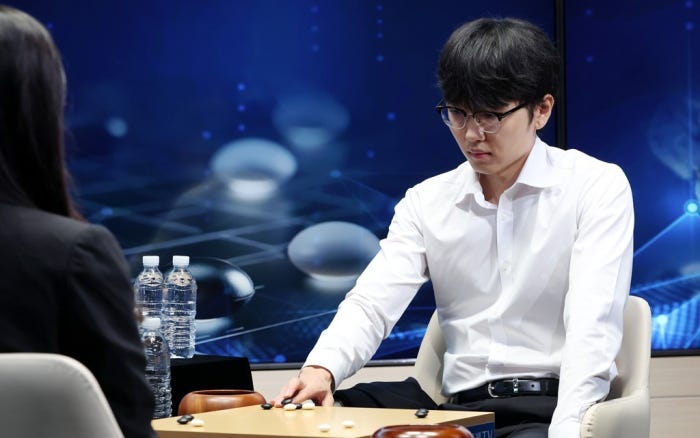
Last month, ten years after Lee Sedol’s historic match vs AlphaGo, the Korean grandmaster Shin Jinseo played a 3-game exhibition match against the AI engine KataGo. He played with a two stone handicap, which is only a slight advantage, roughly equivalent to getting one extra move at the start of the game. After losing the first game, he came back to win games two and three in dramatic fashion.
I reached out to the American Go teacher and streamer Nate Morse (Telegraph Go) to help me understand how to interpret this exciting development. The following is a lightly-edited transcript of our conversation.
Frank: To begin with, could you give a sense, from your perspective, of what this match was about and why it’s significant.
Nate: Yeah. So Shin Jinseo versus KataGo is the first match we’ve had of human versus AI where it was the top human against an AI that we know is superhuman — like, 100% superhuman. When AlphaGo played against Ke Jie, people still thought, okay, AlphaGo is very good, but there’s a chance for Ke Jie. It wasn’t actually true — there was no chance, I don’t think Ke Jie could have possibly won a game.
I’m sorry, when was this? When was the Ke Jie match against AlphaGo?
That was in 2017 — May 2017. So that happened after the Lee Sedol vs. AlphaGo match, and after they had had AlphaGo play some online games.
The Go community has had many games broadcast between AI and top pros casually, and they’re actually quite popular online. So FineArt will play on Fox, and any pro can challenge it and play with a two-stone handicap. FineArt’s win rate in those games is tremendously high — and it’s giving a two-stone handicap, which is roughly an 18- or 19-point handicap. FineArt will win 90% of those games, maybe down a little bit below 90 against the super top pros, but usually above 90 against your average professional player.
And those games, as with most AI versus human games, are sort of casual, in a sense. Each player is getting one minute per move. And many pro players are playing against KataGo on their own in practice, or using other AIs to practice on their own. Sometimes they’ll even upload that. So there have been lots of games between high-level pros and AI, but none that were in the form of a match, or taken seriously, or given any serious amount of prize money. Until Shin Jinseo versus KataGo, here.
And Shin Jinseo is the number one player in the world by a significant margin. He’s more dominant over Go than Magnus Carlsen is over chess, and I don’t think it’s close. I think he’s a lot more dominant.
Shin Jinseo is a spectacular player, so people had been wanting to see him play against top AI. KataGo was chosen, I think, partially because it is open source — anybody can download KataGo onto their own machine, and you can sort of see what KataGo is — and partially because it’s very, very strong.
Part of the reason it’s very strong is that Go players like it a lot. KataGo had a great innovation where it’s actually accounting for points, which is how humans judge the game: by counting points. The prior AIs were sort of doing something else, which is related to counting points when they judge win rate, but not actually telling you a point estimate. So when KataGo started counting points, and people could read that point estimate and learn from it, KataGo was immediately more useful as an educational tool than any of the prior AIs had been.
And so since it was open source and so useful to all the players who wanted to study with AI, people became sort of attached to it, and devoted more energy, just public resources — people donating, essentially, compute to KataGo’s training, which you can do as well if you want, at katagotraining.org.
Is KataGo run by a single person? Is it managed by a team? Is it totally open source now, or is there one main developer?
Yeah, so KataGo was created by a guy named David Wu. He also goes by a couple of nicknames — lightvector is the one he posts under a lot.
KataGo itself, I don’t know exactly how the development is done. I know lightvector is still 100% the lead dev, but when I look it up on GitHub right now, it says there are 52 contributors to KataGo’s GitHub, which sounds about right. People can just go in — it’s open source, so if you have an idea that would definitely improve KataGo, you can contribute. And there are Discords out there — the Computer Go Discord I’m in, where people talk about specific faults in KataGo. If you find a position where KataGo is making a genuine error, that’s the kind of thing the Computer Go Discord people would like to see, because they like to train KataGo on the positions it doesn’t understand. So if you find a position where KataGo is misreading a life and death — usually that will happen in very, very complicated life and death — any example like that, they’re very excited about.
Who set up this match? There’s a car, and a big cash prize. Who was donating that money, and who was organizing this match?
So there were a couple of fans, specifically of Shin Jinseo and AI — the fans of the top Go community — who happened to also be rich Korean businessmen. And so they decided that they were going to set up this match. Apparently, according to what I heard at the US Go Congress, this is the first of a match that they’re going to try to set up once every year, where they pick whoever the number one Go player is at the time to play against the AI. So that’s probably going to be Shin Jinseo next year, and the year after that, and the year after that. But we’ll see. It should be fun.
He’ll need a bigger garage.
Yes, he won a big car for this one!
Am I right in thinking that this match was kind of a big deal? Am I right to be as excited as I am?
It is very exciting. Particularly how Shin Jinseo won the games was very exciting: that in Game 2 he actually fought the AI in the late middle game and still won, and then that in Game 3 he made such a crushing victory that he won by 11.5 points. He had a starting advantage of only 18.5 or so. And so to lose only 7 points throughout the entire game sort of implies — since fair komi should be, like, 7.5 — that he could have fought that game close if it were no komi. Which is absurd. Absolutely absurd. Now, I don’t think it’s really true.
Could you describe a little bit more the difference in the kinds of handicaps? And what “komi” means?
So in Go, Black plays first, so to make the game fair — well, in ancient history they just had players alternate playing black or white, playing first. And then eventually they realized we could also make this game fair, and eliminate draws, by adding compensation points for the player who plays second. And so they gave, at the start, a very low amount of compensation points. I think the first komi was, like, 3.5 points. And then slowly they’ve been refining that total, and nowadays they believe that fair komi, what White should get on a 19×19 board, is something like 7.5 points.
So that compensation is not given in a handicap game. Or, to be precise, in the game that Shin Jinseo played against KataGo it was given as only half a point to KataGo as points compensation — because the point is that Black is supposed to have an advantage. So a two-stone handicap means Black puts two stones down before White gets to spend a move. Effectively this is like: Black plays a move, White passes, Black plays a move, and the game begins, where White gets only half a point in compensation for playing third at that point.
What that amounts to is sort of one and a half passes of advantage — one full pass, and then sort of half a pass that you back out the next move anyway. So one and a half passes is roughly equivalent, in the very beginning of the game, to about 18 or 18.5 points of advantage for Black.
And so that’s why winning by 11.5 is crazy. Because even at 18.5 points, when normal pros were playing against FineArt they were winning 10% of the time at that same advantage. And so to win by 11.5 against FineArt — I don’t think that has ever happened. I don’t know, but it’s an absurd win. Normally when people beat FineArt, it’s only by half a point, or maybe one and a half, or maybe three and a half if they’re insane. 11.5 is crazy. It’s absolutely absurd.
And it probably happens because KataGo was not as aggressive as it’s supposed to be for a handicap game, because some of those features were tuned down a little bit for KataGo this first time.
So after the match, those same benefactors who sponsored the match said, okay, next year we’re going to tune KataGo up, and maybe we’ll try to slowly tune it up, so that each year we play against a stronger and stronger KataGo. So maybe next year it will be pondering on (the AI can think during the human’s turn), handicap mode on, but still two stones. And if Shin Jinseo can beat that, they might go up to the next level of handicap, whatever that could be. Maybe it’s going to be a direct game with zero komi, which is already, like, half a pass of handicap, and they tune KataGo back down to having no pondering and no handicap mode again. That could happen.
There’s all sorts of things that you can do to try to have a fair handicap. Sometimes people, when they practice against KataGo — for example, if I practice against KataGo, I’ll set it so that I play black and KataGo gives me 35 points of komi, because I’m weaker. But I still get to play a normal game, I just have 35 extra points in my pocket. So you can set all sorts of weird restrictions to have a handicap that you think is fair. And it seems like they might be trying to hone in on exactly how strong AI is compared to humans.
I watched your Game 2 and Game 3 analysis — but I didn’t see Game 1. What happened in Game 1?
Game 1, KataGo started with this weird three-space high approach move, which made me believe that it was using the playout doubling advantage, the handicap mode, because it looked so strange. When you’re the stronger player and you want to make the game weird, make the game hard for the opponent, you usually have to do something spicy, a little unusual, in order to make it different from what the other player is used to. And so effectively KataGo did that on move 3, immediately.
After that, Shin Jinseo — I think he said in the interview that he couldn’t really control his mentality. He thought when KataGo played that really strange, weird move in the opening, that that meant KataGo was not going to be playing all the best moves, but just the moves to exploit him. So he played a little too defensively at the beginning. And then when KataGo sort of forced him to play more aggressively — because he had played defensively before, he felt that he had to be too aggressive. He dove into the center, he started a fight, and, as had always happened before, if you fight against the AI you’ve already lost, you just don’t know it yet.
Interesting.
So after that, Shin Jinseo said in his interview that he had a lot of regrets about the quality of the game, and that he just wished to show the fans something better, and try to get to any endgame at all against the AI in the following games. And so he did that and much more in the following two games. Obviously he must be very happy with that.
It’s kind of funny, because from Shin Jinseo’s perspective he’s playing competitive games, extremely competitive games, against players all the time — and the way that it works when you play a handicap game, it’s still competitive, but it’s not the same kind of competitive. You’re playing against time and space as you fill up the board, more than you’re playing against the opponent — especially against AI. You aren’t trying to beat the AI. You’re just trying to smooth over the problems. Make sure that nothing goes horribly wrong, and follow it. Follow the flow.
In game 2 Shin Jinseo used a kind of “space-filling” joseki in the lower right corner (“joseki” are worked-out opening sequences like the named openings in Chess). I remember you saying that the fact that Shin Jinseo knew joseki gave him an advantage over KataGo. And I thought — what does that mean? Why is that an advantage, and why doesn’t KataGo know joseki?
Well, I guess KataGo could have a database of joseki, but the way KataGo interacts with joseki is far more flexible than we humans had interacted with joseki for a long time. And that actually sparked something of an opening revolution after AI. People thought it was going to be us copying the AI in all of its new patterns. And if you want to do that, you can do that. But really what the AI taught us is that if you know any pattern, then there must be some situation where it could stop early — because of the global board state, because of the other things going on on the board, at any time. Basically at any single moment, through any pattern, you could just play away at that time.
Because that can happen, and because the whole board is active at once, you open up a lot of different possibilities for KataGo — or for a human who’s using the same kind of mentality — to outplay an opponent by doing several standard things at once in a way that ends up with a bad result for the opponent. Often you would try to maximize which of the standard choices you would make. And by asking about them in different orders, stopping early, doing this one now, this one now, you can get the opponent to make suboptimal choices with their standard lines of play.
And so for KataGo, if you told it — “hey, you should know this picture, this is a joseki, you should know that picture, that’s a joseki” — you would limit it, a lot of the time, from being able to show its full power. The reason why it’s so good in the opening is its ability to mix and match between the patterns and use its global understanding instead.
So there are basically only a couple of joseki that are actually kind of forcing, that you actually should respond to most of the time. And the one that was played in Game 2 is the most famous and the biggest space-filling sequence of them all.
And so KataGo does not know that its opponent is a human. This is nothing that KataGo is ever told in its process, so it does not know that its opponent could possibly have a database of joseki to rely on. And it just thinks that this really complicated joseki should be really complicated and hard for the human to follow — because if it was the first time ever, there’s no way that humans are going to get through all the complications. Even with years to study, humans are still getting tricked in this joseki by other humans; in competitive games there are still lots of errors.
And so KataGo thought this was going to be really hard for Shin Jinseo, but actually it was just all a pattern that he knew — a foreign concept to KataGo. It’s like if someone didn’t know that you could memorize tic-tac-toe games, and they’re like, how are you doing this? What’s going on?
Is there also a sense in which a big space-filling joseki is inherently good for the handicapped player? Because you’re reducing the amount of space for things to happen which helps you preserve your big starting advantage — is there a sense in which KataGo didn’t see that coming?
Yeah. So KataGo thought it was going to fill this whole corner with a really complicated fight, and then the human played perfectly throughout that fight, because he had memorized all the answers from KataGo earlier.
Is it aware of the fact that it’s playing a handicap game?
KataGo knows it’s losing; it doesn’t think it’s playing a handicap game. KataGo knows it’s down 18.
Does it look at the board and say, oh, there’s an extra black stone? Why is there an extra black stone? It doesn’t reason like that, right? It’s just looking for the best next move. It’s not thinking, oh, what does this mean? There’s no sense in which it’s thinking or reasoning on that level at all, right?
So the way that KataGo uses its understanding of handicaps is that they trained it by having a KataGo with high playouts (playouts are simulations of future moves) play against a KataGo with low playouts, and having both of them try to improve against each other. With a certain amount of handicap — I don’t know how much they trained it with — they would both try to outplay each other. Let’s say you had a KataGo with 800 playouts and a KataGo with 500 playouts, or a KataGo with 800 and a KataGo with 50 playouts, training against each other, evolving. And so they trained a network which is good at playing from a position understanding that it has more playouts than the other KataGo. And they trained another network which is good at playing assuming it has fewer playouts than the other KataGo — which is a funny one, it’s not used very much.
The KataGo which thinks it has more playouts than its opponent is the one that gets subbed in whenever you tell it it’s a handicap game. You’re like, oh, this is a handicap game, and there are two stones of handicap. And then KataGo’s like, oh, okay, so that means if this game were fair, I would have to have this many more playouts than my opponent. So let me go and get the network of policy moves that would work well if I had that many more playouts. And so it’s going to bully opponents more, because it thinks, oh, I can do this really aggressive move that I wouldn’t normally be able to do, because if my opponent is another version of KataGo with only 50 playouts, they’re not going to be able to figure that out. So if they go for it, they’d be guessing; if they don’t go for it, they’d be passive.
I love this so much. This is so beautiful to me because it shows you how complicated it is to answer the question, “what is the best move?” There is a sense in which there is a very simple answer to what is the best move, which is: what is the solution to Go? You have a Go board, and you can just say, black to play and win, and there is just a solution to that, as if it were a puzzle, a list of what moves to make in every circumstance. But this solution is not only beyond the ability of humans to figure out, it’s maybe beyond the ability of any physically-possible computational processes to figure out. So this solution exists but, in a practical sense, is it not something that we have access to. And by “we” I mean humans, and KataGo, and any version of the process we call “thinking”.
The name of this blog is Donkeyspace, which comes from looking at poker, where this kind of thing is happening all the time. There’s a difference between perfect play and good play. Because perfect play is unexploitable — you can’t be exploited — but it leaves lots of money on the table. And the goal in poker is to win a lot of money, not just to be unexploitable. So if you’re playing perfectly against a drunk tourist, you’re playing badly. What does it mean to play poker well? Even if you had access to perfect play, you would be constantly deviating from it, and so would your opponents.
And so what’s happening is you get something like a dogfight between World War II fighter pilots, who are orbiting this theoretical point of perfect play but deviating from it — both in order to try to take advantage of the way their opponent is deviating, but also to give false signals, to trick them into thinking you can be exploited in a particular way, but when they try to exploit you, you come around from the other direction.
But it’s one thing for it to happen in poker, where you’re like, oh, of course it happens in poker, because poker’s all about yomi, mind-reading, second-guessing. But Go — Go is just a math problem, like Chess. How could that possibly be taking place here? And here we see, at the very highest level, it’s in some ways exactly the same kind of thing.
It really seems to me — and I want you to correct me on this if I’m wrong — that the tools Shin Jinseo is bringing to this match are not just his extraordinary skill, which is obviously incredibly high, but also he’s got this other thing, which is his contextual awareness of what is happening: that he’s playing KataGo, that KataGo is a process that he can see and understand. He understands how KataGo selects moves and chooses moves, and he can use that knowledge, that kind of meta-contextual knowledge, which is in some ways like reintroducing strategy at a higher level.
We think of Go as a strategy game, obviously, but in a way, for the computer, it’s almost like it’s all tactics. And Shin Jinseo is demonstrating the re-emergence of strategy at this higher level — the ability to say, oh, this would be a good technique against KataGo in this situation. Is that a good way to think about this?
So, in fact, it’s not really all tactics. If you were to compare Shin Jinseo’s raw reading power versus KataGo in this three-game match, Shin Jinseo was the better calculator, actually. Shin Jinseo is better at reading and tactics than KataGo in this match, in my opinion. However—
In Game 2?
No, all three games.
All three games. Okay.
I think Shin Jinseo is better at actually being able to read. But the problem is, he can read to something, and he looks at it, and he’s like, well, I don’t know, is this good? Or is the other way good? And they’re both completely different, and they’re both him winning by 9, or by 8, or by 7 points. And so then, well, how are you supposed to figure that out? You have to know all the details — which he does know — and then judge them all correctly, which is not humanly possible. And that’s the major difference between AI and humans, actually: that AI is so much better at having an accurate judgment of what is good than humans are. Even though the reading is actually at quite a similar level.
I’m fascinated by this. I want to drill down a little bit more on this topic, because I’m really interested in the difference between search and heuristics — which in some ways is the difference between reading and judgment.
There’s this amazing book, I’m sure you know it, Lessons in the Fundamentals of Go, by Kageyama. And there’s this wonderful thing that Kageyama talks about in relationship to ladders. He talks about how when people are trying to learn Go, they look at a ladder and they think, ugh — what is the heuristic here? Show me. They want a proverb, right? They don’t want to do the boring, stupid thing of having to read out the moves one at a time. Black and then white, then black, then white, then black, then white. The brain resists it.
And I see this all the time in games. In many games there’s this tension between what people want, which is to be in the sweet spot of improvisational problem solving and cleverness, relying on epiphanies of strategic wisdom, like Sun Tzu. I think of it as the Sun Tzu Fallacy: that winning in a strategy game means knowing the right clever shortcut. And what Kageyama is saying is, look, there really isn’t one. You just have to do the reading, black, white, black, white...
But now you’re telling me — I mean, I would have assumed that that was really the strength of—
Most people assume that robots should be good at calculating.
Because they do all of these readouts. But you’re telling me now that what they’re good at is actually judgment, which is based on what? Just kind of compressed knowledge? How should I think about this? Should I be changing my understanding of heuristic versus search?
So this is the reason why it required AI to be able to actually get good at Go, and not just any old computing program. People thought computers themselves were going to be really bad at Go for a long time, and were surprised that AlphaGo was able to beat Go masters so early. It’s because AI was required.
And what AI is doing that is so much better than humans is it has a sort of black box that is taking information in from all of the points, and molding it together into a win rate judgment — and then also, for KataGo, a points judgment of the board, of how winning a board is for either color. And that is the biggest separator between human and AI. KataGo is so much better at judging board states, how good they are for either player, than humans are.
It’s so hard for me, for my puny brain, to understand how it judges a board state. It’s not just doing a little extra reading, right? It’s not looking at the board state and saying, what would happen if I look just a few more steps? It’s actually just looking at it and it’s just… vibing? Is that a good way of putting it? It’s just saying, this board state is good, it’s just better.
Yeah. I think there are 502 different, what they call, channels, where it extracts different information, and so each of those channels will tell it a different kind of vibe. So there are a couple of channels dedicated to, is there a ladder that’s going to hit something? Okay, there’s a ladder there. And there are a couple of channels dedicated to other sort of direct things, like, oh, these are all the spots where white could move to next. These are all the spots where black could move to next. Oh, these are all the spots where I think the next move should probably be. And so there are 502 of these layers, most of which are not that simple. Most of which are very complicated and sort of obscure to our human puny brains.
And KataGo takes them all, and through AI-trained, we-don’t-know-exactly-what-it’s-doing math — like, we know the math behind it, but we don’t know what the weights are doing — it molds those all together into the win rate. And so it is just vibing, but it’s a whole bunch of different ideas of vibing with the position, all mixed together into one.
And it does have some reading-like things folded into that process. But it’s not doing it explicitly, like reading out next likely moves and directions and stuff?
No, no, no. Those are all vibes.
You mentioned once that you thought KataGo was within one full stone of perfection.
Yes.
What does that mean, and why do you think it?
So, because at the level which KataGo is at, the game is actually no longer tactical almost at all when KataGo plays against itself. It becomes entirely strategic. When KataGo plays against itself, it is going to barely be able to win anything at all. And when they have the big AI versus AI tournaments, when KataGo plays against other big AIs, it can only barely win anything. The AIs can only barely beat each other.
Does that mean that they end up tying, or do they end up very close, within half a point?
In human games, you would expect the score to be going up and down as players make mistakes. Making a one-point mistake could almost be called severe at Shin Jinseo’s level. But to make only a 0.1-point mistake, where the game should still be at roughly the expected outcome, but maybe it wasn’t quite the most open way to get there, or the most pressing way to get there, compared to all the other ways where you could have tried to win by half a point or whatever — to make that level of mistake is common, and it’s the kind of thing which is sort of uncontrollable. You know: okay, I did this, and I’m going to win by half a point, and you did that, and you’re going to win by half a point, but your way turns out maybe it could be a little better, depending on how the game is going to play out. There are all sorts of situations like that in Go. And it’s difficult to learn, as a human, how to do them all perfectly. How to absolutely nail that.
And so normally, when KataGo, or any AI, is beating a human, it’s constantly gaining, occasionally through a 3-point mistake, or some noticeable error that the human makes, but mostly through a slow grind, where the human just does something maybe a little bit wrong, but the game should still be roughly the same. If you make five 0.2-point mistakes, maybe you could count one of them as being a one-point mistake, but you wouldn’t actually do that. They’re all so small as to be nearly unaccountable. And so that’s what normally happens when humans play against AI.
So when Shin Jinseo wins by 11.5 points, and he lost 7 points throughout that game, he did not make any mistakes — anything that you would call, like, oh, that was not correct. It was only slowly sliding, and usually those slides were controlled by Shin Jinseo in that particular Game 3 against KataGo, where he was intending to slide backwards a little bit in value in order to simplify the game for himself in the future.
I love the point you made in the commentary where you explain that he’s basically spending his advantage to simplify the game. He’s consciously trading off some of his optimal value to simplify the game and get to the end. But then he’s got to be careful to balance that against the fact that he’s also subconsciously or inadvertently leaking value.
Yeah. So when KataGo plays against itself — the reason why I think it’s within one full stone of perfection: to be honest, already that is generous. If a perfect player just showed up and played against KataGo — perfection without knowledge of what KataGo will mess up — I would be surprised if the perfect player is gaining more than komi throughout that game.
Okay, so that’s what you mean. That if we had access to an oracle which had the solution to Go and just knew the actual correct moves, you think that KataGo and other current state-of-the-art AI would still be within 7 or 8 points of that.
Yeah. So one full stone is more like 14 points, and I’m pretty confident about that. Komi, I’m a little less confident about, but I still sort of believe it.
When I studied a KataGo vs. KataGo game before — and I’m studying one also now, for a YouTube video — those games are so unbelievably high level. I thought that KataGo made a mistake, because it failed to anticipate a tesuji, like, 50 moves down the line. So I thought, oh, it must not have realized that this kind of tesuji can happen, where eventually the player that made the tesuji was going to win by 2 points. And then the person who ran KataGo on that had the metrics, and it turned out KataGo had in fact not missed that tesuji — it’s just that it was sliding backwards in that sort of unknowable way that I was talking about with Shin Jinseo sliding. KataGo was sliding against KataGo in that way. Sometimes you just can’t control this game, it’s too complicated. But it actually knew about that tesuji that was 50 moves out that I had never seen before. It knew about that, and it played into it because it thought that’s the most complicated way to try to avoid losing by a point.
So, ten years ago Lee Sedol lost to AlphaGo, which felt so historically important and interesting. And now, a decade later, we have this new match, which also feels important, but in a way that feels weirdly optimistic. It’s like, okay, now we know — we’ve lived for 10 years in this world with superhuman Go AI, and it’s maybe not as different as we thought. Maybe it’s not as strange and alien and weird and unfathomable; we’re starting to kind of fathom it.
But I want to compare the two matches a little bit. Was there anything from this match that is comparable to some of the big, surprising things that happened in AlphaGo — like move 37, the shoulder hit on the fifth line — which people were really shocked and surprised by? Was there anything in this match, or do we just understand KataGo well enough now that there was nothing in this match that was a big surprise?
So there were some surprising moments from KataGo. Because it’s an open-source model, of course everybody can run along with their own KataGo at home. And so, for example, that first move that KataGo played, the three-space high approach: given that KataGo is not playing with a playout doubling advantage, it is extremely rare that KataGo could play such a move. It’s very unusual, actually.
And KataGo is actually not deterministic, the way that it works. It has a little tiny, tiny bit of randomness involved when it pulls which one of the moves that it likes a lot — not which one it should pick, which one it should read, which one it should pick to look into a little more. And so it’s theoretically possible that it could have randomly decided on that particular move, but it’s astoundingly unlikely, I have to say, from the way that I understand how KataGo works. Something very unusual happened when KataGo played that move 3 of Game 1.
Game 2 also had some unusual moves later in the game, when Shin Jinseo was surviving KataGo in a fight, something that’s never been done before. It’s likely that if KataGo were tuned to handicap style, it would have made that a bit harder on Shin Jinseo, and could have won the game. So it made some, what you might call mistakes, during that fighting. I don’t think I could call them mistakes, but maybe moves that made it slightly less likely to win — although it was losing the whole time.
People at home running their KataGos with huge amounts of playouts, and longer time than KataGo was using to think, were coming up with some different moves, so in that sense people were like, I don’t know, this seems a little suspicious. But there was nothing that is going to break open a new opening theory, or a different realm of play for humans. As a matter of fact, humans are generally not applying most of the lessons that they learn at the top level from playing against AI into their matches against other humans anymore. They’re generally just playing against other humans by themselves.
Another thing that I remember from the Lee Sedol match against AlphaGo was the “slack” moves — moves that seemed to be less aggressively optimal to our eyes. My understanding of it afterwards was that this was due to the difference between how humans evaluated situations — by a player being ahead in terms of a number of points — and how AlphaGo looked at situations, which is by win percentages. And if you maximize for win percentages, you’re actually not maximizing for number of points.
And that seemed to me like such a deep insight. It’s like, oh, we’ve been doing it wrong all this time. Because we have this crude heuristic, where because we’re not able to look at win percentage itself, we have to use this proxy, which is really clumsy. And in fact I thought of it as being almost like a deep moral lesson: how often are we using a kind of scorched-earth method of totally destroying our enemies, when in fact all we need to do is win by a small amount? We should be maximizing our win percentages, not going around trying to crush everything in our path, like Conan the Barbarian.
But now I’m not so sure, because when you talk about this stuff, you’re like, well, humans still like the point method, and in fact that in some ways remains a more useful way, and KataGo has the ability to show the state of the game that way, and we kind of like it. So how do we think about these two different ways of looking at advantage?
If I could get an AI win rate during the game, which I could generate by myself, I would do that. But I cannot, and neither can Shin Jinseo. He cannot just do that. He can take a guess. But his guess is going to be based on what’s happening in the game. And the easiest way to figure out what’s happening in the game is to count the points. That’s by far the easiest. And then the harder way is to understand what’s going on with the weird stuff that’s not yet points.
And the stronger you get as a Go player, the more you can do with that, the more you can understand those positions, how many expected points you should get from positive amounts of expected territory, or negative amounts, like debts that you have throughout the board. And you’ll start to understand that, and slowly be able to coalesce it into another balance, which I personally call the balance of power. Which you can score, if you like — oh, this guy’s got an advantage in the balance of power, we should expect that they get, like, 5 more points over there. And you can compare that with the balance of territory, add it all together, to get one number. Or you can say, okay, the current balance of power is something like this, and according to the balance of territory, black would need 30 more points from this balance of power to win. Does he have that much? And you get a feeling: well, do I think I could make 30 points from this amount of balance of power or not? I don’t know. And you can say, oh, I’m a slight favorite, because I think I could probably make 30 points out of this.
And so this is the way that humans are looking at the game. You’re looking at it thinking, oh, I’m a slight favorite, or oh, I’m a heavy favorite, I could make 40 easily. Or, oh, I don’t think I could make 30 points, I must be behind, let me do something more. And you can get a very continuous scale of that. And so if I could look at the AI win rate, the AI win rate would reflect that continuous scale, except without making judgment errors, without being wrong about something. And that’s what the win rate was, basically.
But KataGo is using the points judgment as well. And KataGo is actually using that points judgment in its decision making. And so KataGo is no longer slack, because it has that points judgment, and because it is using that in the decision-making it will prioritize winning by a few more points than half a point.
Ok, so Conan just remains with us. We can’t shake him yet.
Chess has changed a lot because of the eval bar, right? I’m a casual Chess observer, and for me it really helps as a way of observing the game. Is there an equivalent now when people are watching Go?
Yeah, so some people are putting eval bars up on their broadcasts. The way that it works now is that they’re filling up the white and the black based on the win rate that KataGo gives, and then they’re also putting the score. It’ll be, you know, the white bar will be crushing the black bar, and it’ll tell you white by 16.5, or 16.7, or whatever KataGo is telling you. And that eval bar is useful for helping viewers follow the game.
Of course, some Chess broadcasts will use it and some will not, and it’s the same thing with Go broadcasts, depending on who the expected audience should be and the personal opinions of the broadcasters. You may or may not end up actually using that eval bar. But it does exist, and it can help to judge the games. Figuring out who’s winning in Go, as I just described, is kind of a complicated task. You have to count up to 60 for both sides, and then also do judgment on the hard stuff that the strong players are better at doing than the weaker players. So it is kind of nice to have a shortcut available for that judgment.
One of the things that happened with KataGo is that a year or two ago there was this discovery of adversarial policies. Tony Wang and other researchers spent years training an AI against AlphaGo, and against KataGo, which inherits a lot of AlphaGo’s logic, as I understand it.
And eventually they found a major weakness in KataGo’s ability to correctly understand life and death situations when they were nested groups. That was the thing that I learned from watching Nick Sibicky on YouTube.
Is there anything remaining of that? Was that completely corrected in KataGo? Are there traces of it? Is there a sense that there are other possible adversarial strategies lurking within KataGo? Was that at all part of how Shin Jinseo won these games?
It was not at all part of how Shin Jinseo won these games.
Okay.
However — I think Shin Jinseo, if he wanted, could have tried, but that would have been lame, because anyone could do that, and you want Shin Jinseo to play KataGo for real. And nowadays, if anyone tries that against KataGo, it’s not going to work. The most obvious adversarial ways are sort of patched. What they did is they just took KataGo and trained it on those positions where it was messing up. And then it got good at those positions, so now it’s not going to mess up like that anymore. And again, if you have some type of position where KataGo will mess up, they want to train it on those positions.
The thing about the adversarial strategies is that I totally believe that many exist. In fact, you can find mistakes in KataGo. If you really understand what you’re doing, it’s not that hard to find mistakes in what KataGo is telling you. So when Shin Jinseo gave us a couple of translated commentaries to Baduk TV about his world championship games, he would sometimes mention: okay, and then this move is the KataGo recommendation, but I believe that’s one of the KataGo errors, and that this move is actually the correct move. So there are a few of these things still there.
It’s just that these days, those errors are on the scale of KataGo trying to win strategically, in the same way I discussed earlier, where it’s trying to make it so that the opponent has a small slide down to lose by a point. KataGo wants a small slide, and so it will still have plenty of errors. When KataGo plays against itself, it can win, and, you know, the other KataGo will make mistakes.
The thing is, the ring example, that particular adversarial strategy, was very, very easy for humans to understand. And there’s no particular reason why the patterns of positions which KataGo is messing up have to be easy for humans to understand. It’s just that we picked the one which was easy for humans to understand, and that became famous. So I totally believe there are many patterns of positions which KataGo is messing up, which could be understood, but are not that easy. That are not that basic.
The lastingness of those is kind of — they’d have a short lifespan anyway, because you would just train KataGo on whatever it was that it didn’t understand, and then you’d just get a stronger KataGo. So to me, I think those adversarial strategies are kind of boring, because they only exploit the current KataGo, and it can just be trained past whatever you came up with. And it’s not really about Go. It wouldn’t be that interesting to try to find adversarial strategies against Shin Jinseo, or some human player, because of course he’s going to make mistakes. And KataGo is the same. KataGo is just a Go player. It’s a very, very, very good Go player, but if you really want to hunt down its mistakes, of course you’ll find them. It’s just kind of rude. Why would you bother doing that? There’s no purpose to it anyway, for the most part — at least as far as my opinion is.
I would like to ask about your personal feeling about Go as a game — the beauty and pleasure of Go — and how you think that is affected by our access to superhuman Go players. And how Go is changing, and maybe Go as culture, Go as ceremony, as something like a martial art, or even like a spiritual discipline. Are these things changing in the era of AI? And is your perspective on the beauty in Go, and what you love about it, evolving and changing?
So I started playing Go after the AlphaGo–Lee Sedol match. So when I started there was already some amount of buzz, but before there was any public AI or anything close to that available.
In terms of the regular Go players, how they interface with Go and how they interact with it, comparing before AI and after AI: by far the biggest difference is that weak players will believe that there is an answer to something. So they’ll think, oh, I played the wrong move there, and the right move was that one. And so players who are not dan level will be far too confident saying that something is the right move, compared to before, if KataGo agrees with that.
And so there’s a little bit of a problem with that. When I learned Go, I would play a game, look at it afterwards, and be like, oh, I think when that happened, that probably wasn’t good for me. Maybe I should have done it that way instead. I’ll try it next time. And I wouldn’t know that it would be better to do it the other way, but I had a guess. I thought, oh, probably that way it would be better. And that sort of made it more of an exploration.
Compared to — the most toxic way to view Go is like an answer sheet, like what you were describing before. If you as a player are thinking, oh, Go has an answer sheet, then that means when you can’t find the answers you’ll be frustrated, which is just not at all how Go works, or how you’re going to have fun if you play the game. Go isn’t an answer sheet, it’s an exploration with the other player. Both of you are trying and seeing what’s going to happen.
The way that AI has changed things for stronger players is different. For weaker players, in general, I just don’t think it’s that important, and if you just pretend it wasn’t there, then you’ll have a good time. And if you do use it when you want to, you’ll have a good time, fine.
For stronger players it’s a bit different. It does have more of an impact. In particular, it’s making it easier for people like me to study and learn concepts. Because I can directly ask KataGo a question — not verbally, but by saying, hmm, I have a theory, I bet if I played it like this and that, then you’d give me half a point higher score. And then I test. Oh, no, you gave me minus 3 points. I wonder why that is. Hmm, let me think about it. And I can refine my theory like this.
You used to be able to do that, but only by sort of trusting the word of stronger players, and you’d probably have to go to Asia to get enough stronger players to do that. Nowadays I don’t have to go to Asia, I can play the same players online if I want; they’re not going to take it as seriously, but it still works. And I can get the theory, I can get all my questions answered, if I know what I’m doing and I interface with KataGo in a healthy way. And so in that way it’s been a really nice educator for people like me, and also plenty of people in Asia are doing the same thing, because you can’t always be talking to a 9 dan pro, even if you live in Korea. There’s only so many of them to go around.
Then for the actual top pros, I think they also are learning from AI. And the way that they interface with AI, I don’t really know that well, but for a large part it seems to have made it so that games are a little less about memorizing long joseki in the opening. Although, the more that you understand and memorize the AI principles of openings — so that you could maybe not know the full sequence, but understand the way that AI would be approaching these openings — the more you’re going to be able to outplay the opponent as well. So there still is memorization involved, but it’s just not about sequences anymore. It’s more about opening principles than exact sequences.
There are some openings which are sequences that you need to learn, like the flying knife, but less so, I think, than before AI, where there were many that humans would just accept as being trick plays that are there, that you have to know all of it — the Large Avalanche for example, if you want to be able to play Large Avalanche against a pro. Just how it was.
So in general, the culture after AI has largely gotten better, so long as people are using AI in a healthy manner. There are moments when people are being rather toxic in their use of AI, whether it’s by assuming the AI is right, or by not asking it questions and just looking at the answers first, so then you can’t generate a question. There are many ways to use the AI in unhealthy ways. And it doesn’t come with any warnings or anything like that. But for the people who are able to use AI in healthy ways, it has helped them, and the people who haven’t can just not use AI. So for the most part I view it as a positive — with the exception of the people who cheat. The people who are using AI to cheat in their games: it’s unfortunately really prevalent online, and so that’s quite annoying. But other than that, I think it’s been a positive.
Are human players stronger than ever? Do you think Shin Jinseo is the strongest human player in history?
Yes, Shin Jinseo is the strongest human player in history. I don’t actually think it’s that close. Although — I think that the old masters, like Go Seigen and all those players, like Honinbo Shusaku—
Invincible!
Yes. If they grew up in this time, and they also had AI, then their openings would be more AI-approved, they’d probably be stronger, presuming that they grew up with all the other resources that they had and more. And they very well could have given the other top players a run for their money even without that, I think.
Shin Jinseo is too far ahead. I think that if we took those super talents of the past and gave them AI, they could match Shin Jinseo — it’s possible, I don’t know. This is, like, an anachronistic, hard-to-say thing. But even without that, they can already nearly match the other, like, top 50 Go professionals. But I don’t think they can match Shin Jinseo. He’s the best player ever.
Where do you go to stay current with what’s happening in the world of Go AI?
I just browse the Computer Go community Discord, if I need to. And for the most part I don’t understand what they’re talking about, but sometimes I do. I was fortunate enough to get to talk a lot with David Wu, the creator of KataGo, during those Shin Jinseo vs. KataGo matches, and he also released a post recently that I thought was really interesting, about how KataGo, whenever it trains, is automatically learning some hexagonal symmetries over the Go board. Which you would think is absurd, right? But it’s been replicated a couple of times, and these hexagonal symmetries aren’t even lined up with the lines — none of those symmetries are lined up directly with the square grid. It’s just off the grid, hexagonally symmetric, in one of those layers, I think.
So yeah, that was an interesting find by him. There’s some crazy stuff going on in computer Go. It just goes to show, whatever KataGo is doing, we don’t really know. There’s a lot of that black box, which is just completely weird, and that’s the kind of stuff which could be figured out slowly. I feel like with AI, we got to sort of skip a technological step by just having it learn, and a lot of the stuff it learned is beyond our technological understanding — although we could have made the same thing if we were smart enough to make all those same layers that KataGo has sort of designed for itself. Which would be an immensely futuristic project.
In general, all this stuff is very cool. KataGo is brilliant, it’s superhuman, it’s, I think, the most brilliant example of AI that exists currently in the world.
The most interesting thing about the progression of AI is I strongly believe that the other fields AI is learning in will get as good at their field as KataGo is at Go someday. Probably not anytime soon, for most of those fields, but someday. And KataGo itself is fallible. It’s not human, but it is just a Go player, and it does have these mistakes that you can be antagonistic towards. So AI, even when it gets to be super-duper superhuman — way more than just regular superhuman like KataGo is — it will still be fallible. So you shouldn’t trust it, especially in the other fields where it is not even remotely close to as good at what it’s doing as KataGo is good at playing Go.
But yeah, even though there are all these problems with AI these days, it’s still really cool to be here as we’re watching it.
I agree, and this has made me more optimistic, in a way. I think this example of how AI can still participate in a thing — can be superhuman in its abilities, and still be contributing collaboratively to a shared project, like Go, and deepening our appreciation and understanding of it, and making it even more beautiful. I find that to be very optimistic and hopeful.
Yes. That’s basically what happens when the top pros learn from AI. These days, they’re only learning ways to be more creative. That’s all. And that’s very fun. That’s very nice. The craziest things that AI is telling them are all ways where you can be a little more creative, a little cooler, a little more beautiful. And hopefully that’s where all the rest of the AIs will lead us, someday.
Nate’s Patreon: Telegraph Go, his YouTube channel: Telegraph Go, and you can email him at: telegraphgo@gmail.com.
This was a really beautiful breakdown of the many ways games can teach us about the new frontiers of knowledge, and the extent to which models can approximate our paths through them.
fascinating interview! ty monty. i know nothing about go so it's like listening to a podcast about an alien sport for people with seven limbs and a tesseract for a ball